Week 2: Anthropology before and after the liberal settlement
ANTH 3623: Reconciling justice with anthropology (Semester 1,
2026)
March 2, 2026
Main reading: Evans-Pritchard (1940); Bohannan ([1957] 2018)
Other reading: Mazzarella (2019)
Slides available at https://anthrograph.rschram.org/3623/2026/02.
Notes
Anthropology is born in Europe and the European intellectual tradition. It takes flight from this origin to develop new versions of a critical tradition of European thought which was skeptical of progress or modernity. The societies outside of Europe that most interested early thinkers in anthropology were societies based on kinship, and represented for them a fundamentally different basis for society. The main difference was that these societies lacked a state… and were fine that way. The statelessness of acephalous societies was not a lack or a deficit but was, in the right light, a demonstration of the capacity for communities to govern themselves. This anarchist element in anthropology was important to early British social anthropologists and has been revived by Joanna Overing and David Graeber among others. Should anthropologists renew their contribution to a theory of anarchism?
Radcliffe-Brown on Australian Indigenous societies
If we are to understand aright the laws and customs of non-European peoples we must be careful not to interpret them in terms of our own legal conceptions, which, simple and obvious as some of them may seem to us, are the product of a long and complex historical development and are special to our own culture. If, for instance, we attempt to apply to the customs of the simpler peoples our own precise distinctions between the law relating to persons and the law relating to things we shall produce nothing but confusion in the result.
With us one of the most important aspects of succession is the transmission of property by inheritance. Yet in some of the simplest societies this is a matter of almost no significance at all. In an Australian tribe, for example, a man possesses a few weapons, tools, utensils and personal ornaments, things of little value or permanence. On his death some of them may be destroyed, others may be distributed among his relatives and friends. But their disposal is of so little importance, unless in relation to ritual, that it is often difficult to find any rules of customary procedure. But even in such simple societies, where inheritance of private property may be said not to exist or to be of minimal importance, there are problems of succession in the widest sense of the term. (Radcliffe-Brown [1935] 1952, 32)
Radcliffe-Brown proposes the term ‘horde’
Let us next consider, in such a tribe as the Kariera of Western Australia, the nature of the group that I shall call a ‘horde’.
This is a body of persons who jointly possess, occupy and exploit a certain defined area of country. The rights of the horde over its territory can be briefly indicated by saying that no person who is not a member of the horde has the right to any animal, vegetable or mineral product from the territory except by invitation or consent of members of the horde. Acts of trespass against this exclusive right of a horde to its territory seem to have been very rare in the social life of the aborigines but it appears to have been generally held that anyone committing such a trespass could justifiably be killed. (Radcliffe-Brown [1935] 1952, 33–34)
What do you infer about Radcliffe-Brown as an author given the way we frames his argument about different systems of succession?
Who do you think Radcliffe-Brown is?
What does his language say about him?
Reflect on your weekly assignment: Evans-Pritchard’s conclusions
Think about your weekly assignment for this week. Read it again, or take out a piece of paper and write one sentence with your answer now.
In his chapter on the Nuer political system, Evans-Pritchard writes:
In the strict sense of the word, the Nuer have no law. There is no one with legislative or juridical functions. […] [T]here is no constituted and impartial authority who decides on the rights and wrongs of a dispute and there is no external power to enforce such a decision if it were given. (Evans-Pritchard 1940, 293)
And if the Nuer has no law, he likewise lacks government. […] Every Nuer, the product of a hard and equalitarian upbringing, deeply democratic, considers himself as good as his neighbor; and families and joint families, whilst co-ordinating their activities with those of their fellow villagers, regulate their affairs as they please. (Evans-Pritchard 1940, 294)
The Nuer constitution is highly individualistic and libertarian. It is an acephalous state…. Nevertheless, it is far from chaotic. It has a persistent and coherent form which might be called “ordered anarchy.” (Evans-Pritchard 1940, 296)
In his conclusion, Evans-Pritchard also notes the emergence of “prophets” in recent years, whom he concludes “[symbolize] … the unity of the tribe” in a way that no person or institution has ever before (Evans-Pritchard 1940, 295).
Which is, for you, the most important fact to understand about Nuer life and why?
The south coast of Duau (Normanby Island), within Papua New Guinea
A Google Maps image of Normanby Island with a placemark on Kurada, a Catholic mission station on the lands of the Auhelawa (Ulada) people
Figure 1: A Google Maps image of Normanby Island with a placemark on Kurada, a Catholic mission station on the lands of the Auhelawa (Ulada) people.
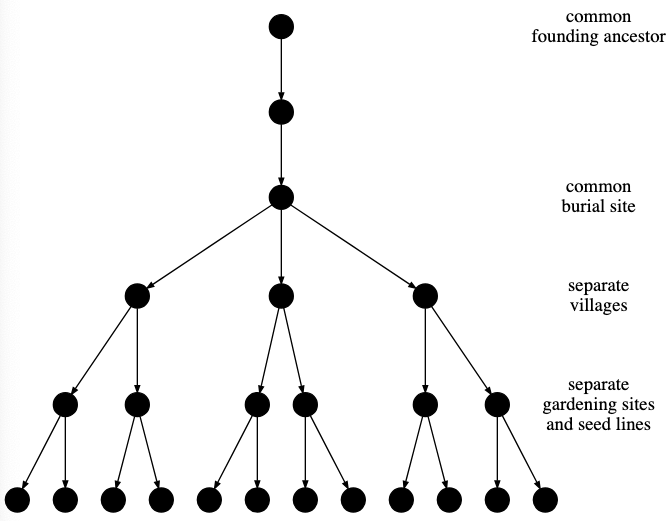
Segmentary order: Nested levels